The path to product-market fit: A founder’s guide to MVPs, scaling, and beyond


Illustration by Freepik
Building a high-growth digital product is rarely about having the "perfect" idea; it is about having the most disciplined execution. At Studio Soren, we’ve seen countless founders approach us with a "Version 1.0" blueprint that looks like a spaceship, only to realise that the market actually just needs a better bicycle.
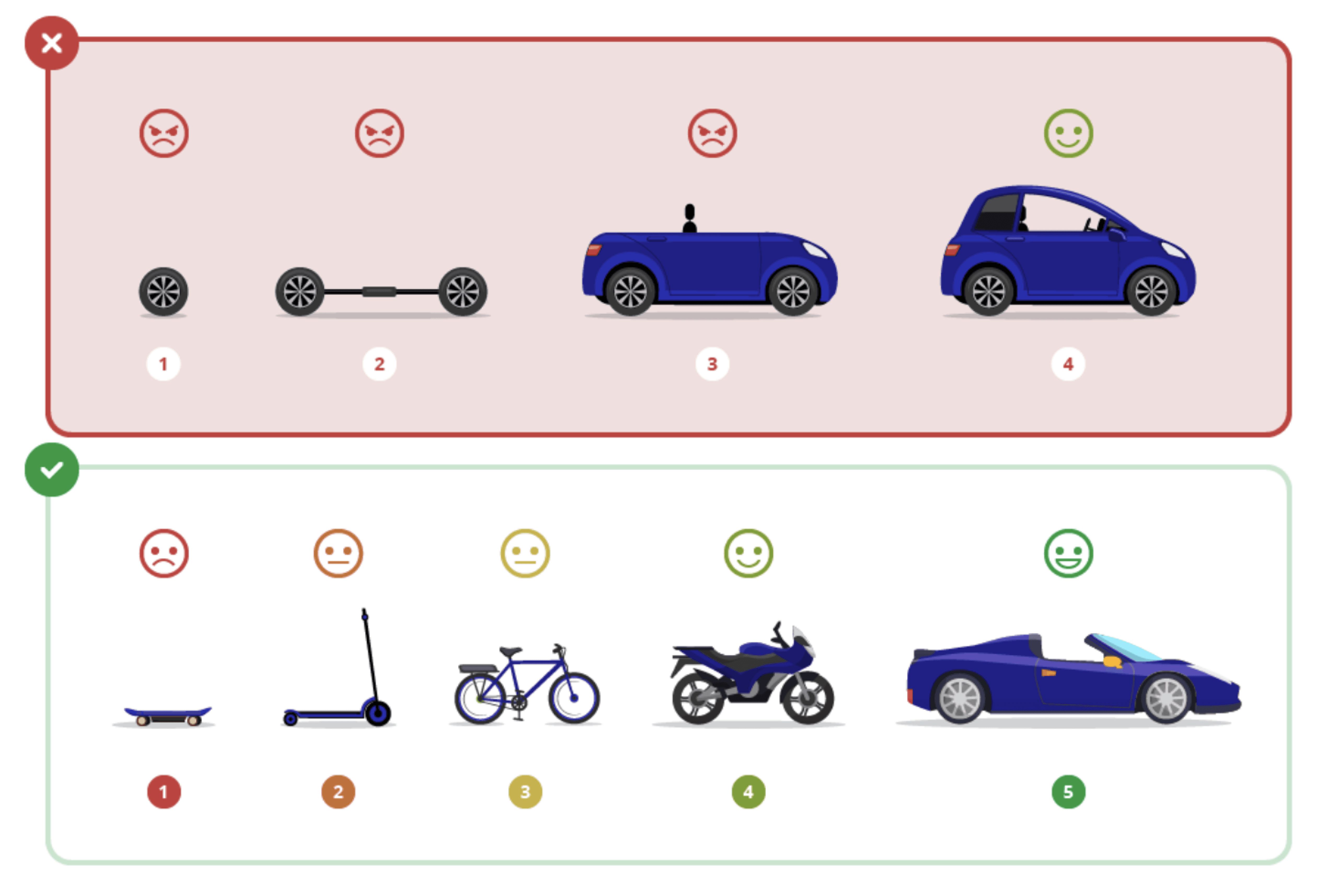
The image above (by Mlsdev) a classic in the world of Agile development—is the "North Star" for product managers. It highlights the fundamental difference between Incremental Construction (building parts of a car that don't work until the end) and Iterative Evolution (building functional tools that get better over time).
In this deep dive, we’re going to explore the mechanics of the MVP, the nuance of Alpha and Beta testing, and the rigorous requirements for scaling design and software at a professional level.
The Philosophy of the MVP (Minimum Viable Product)
The term "MVP" is often thrown around in boardrooms, but it is frequently misunderstood. Many see it as a "cheap" or "half-baked" version of a product. In reality, a true MVP is a high-precision tool for risk mitigation.
The Skateboard vs. The Car Wheel
Look at the top row of our header image. The goal is a car. Stage 1 is a wheel. Can you go anywhere on a wheel? No. Stage 2 is an axle. Still useless. You don't have a functional product until Stage 4. This is the "Waterfall" trap. You spend 12 months and $200k building something that might not even be what the customer wants.
Now, look at the bottom row.
The Skateboard (Stage 1): It gets the user from A to B. It’s manual and bumpy, but it solves the core problem of movement.
The Scooter (Stage 2): You’ve added a handle. Now it’s easier to steer.
The Bicycle (Stage 3): You’ve added efficiency.
The Motorcycle (Stage 4): You’ve added power.
By the time you reach the Convertible (Stage 5), you haven't just built a car; you’ve built a loyal customer base that has told you exactly what kind of car they want.
Why the MVP approach is mandatory in 2026
In today’s market, the cost of customer acquisition is higher than ever. If you build a full-scale platform without validating the core value proposition, you are gambling. An MVP allows you to:
Validate Demand: Do people actually have the problem you think they have?
Reduce Time-to-Market: Get in front of users in weeks, not years.
Pivot with Ease: It is much easier to turn a skateboard into a scooter than it is to turn a half-finished car into a boat.
Navigating the Stages – From Alpha to Beta
Once the concept is validated, the product must move through the technical gauntlet. These stages are where the "magic" of software development happens, moving from a buggy prototype to a stable, market-ready solution.
The Alpha Stage: The "Founders' Build"
Alpha is an internal phase. At Studio Soren, this is where our engineering team and the client’s internal stakeholders live.
The Focus: Logic and Architecture. We aren't worried about the color of the "Submit" button yet; we’re making sure the API calls don't time out.
The User Base: Usually restricted to the development team and "friendly" internal testers.
The Goal: To find the "Showstoppers." These are bugs that would cause a total system failure.
Design State: Low-to-medium fidelity. We use Figma prototypes to map out user flows, but the actual code might still have "placeholder" assets.
The Beta Stage: The First Contact
Beta is where the product meets reality. You open the doors to a select group of external users—often called "Early Adopters."
Closed Beta: Invite-only. You want users who are tech-savvy and forgiving of small bugs in exchange for early access.
Open Beta: The final "stress test" before the general launch.
The Goal: UX validation. Does the user understand how to get from point A to point B? We use tools like FullStory or Hotjar to watch session recordings and see where users get frustrated.
Feedback Loops: This is the most critical time to listen. If 80% of your Beta users are ignoring a feature you spent 3 months building, you need the courage to kill it.
Scaling Design – From One-Offs to Systems
Scaling a product isn't just about adding more servers; it’s about ensuring the User Experience (UX) stays cohesive as the feature set grows. If you don't scale your design properly, your app will eventually look like a "Frankenstein" of different styles.
1. The Design System (The "Source of Truth")
As your product grows, you cannot design every page from scratch. You need a Design System. This is a library of reusable components—buttons, input fields, modals, and navigation bars—governed by clear standards.
Consistency: Every "Buy" button should look and behave the same way.
Efficiency: Developers can pull pre-made components from the library rather than coding a new button for every page.
Reference: Check out Material Design by Google or Carbon by IBM for gold-standard examples.
2. Accessibility (a11y) and Inclusive Design
Scaling means expanding your user base. That includes users with visual, auditory, or motor impairments.
Color Contrast: Ensure your text is readable for those with color blindness.
Screen Reader Support: Proper HTML semantics allow assistive technologies to "read" your app.
Global Reach: Scaling often involves localization. Does your layout break when the English text is translated into German (which is often 30% longer)?
3. Emotional Design and Micro-interactions
In the "Motorcycle" and "Car" stages (Stages 4 and 5), the goal moves from "Function" to "Delight." This is where we add micro-interactions—the subtle animations when you "Like" a post or the satisfying haptic feedback on a mobile device. This is what builds brand loyalty.
Scaling Software Development – Building for 1 Million Users
The "Skateboard" version of your app might run on a simple server. But if you try to put a jet engine on a skateboard, it will shatter. To scale to a "Convertible" level, your architecture must evolve.
1. From Monolith to Microservices
In the early days, a Monolithic Architecture (one big codebase) is faster to build. But as you scale, it becomes a bottleneck. If one person changes the "Checkout" code, it shouldn't break the "Login" page.
Microservices: We break the app into smaller, independent pieces that communicate via APIs. This allows teams to work on different parts of the product simultaneously without stepping on each other's toes.
2. Infrastructure and the Cloud
Scaling requires "Elasticity." Your traffic will spike on Monday mornings and dip on Saturday nights.
Containerisation: Using Docker and Kubernetes allows us to package your app so it runs identically on any server.
Server-less Computing: Services like AWS Lambda allow you to run code without managing servers, only paying for what you use.
3. Database Scaling: SQL vs. NoSQL
The way you store data changes as you grow.
Vertical Scaling: Getting a bigger, more expensive server (limited).
Horizontal Scaling: Spreading the data across many servers (unlimited).
Choosing between a relational database like PostgreSQL or a NoSQL database like MongoDB depends entirely on your data structure and scale goals.
Part 5: The Studio Soren Methodology
At Studio Soren, we specialise in this journey. We don't believe in "set it and forget it" development. We believe in the iterative cycle of:
Build → Measure → Learn.
Discovery: We help you identify the "Skateboard"—the core value of your idea.
Agile Development: We work in 2-week sprints, ensuring you see progress constantly.
Technical Debt Management: We build for today but plan for tomorrow, ensuring the code we write for your MVP won't have to be thrown away when you scale.
Why Partner with a Studio?
Building a "Convertible" requires a diverse team: UI/UX Designers, Frontend Engineers, Backend Architects, and DevOps Specialists. Most startups cannot afford to hire all these roles full-time in the beginning. By partnering with Studio Soren, you get an "on-demand" executive-level team that scales with you.
Conclusion: Don't Build the Car First
The path to a successful digital product is littered with the remains of "perfect" cars that never left the garage. Success belongs to the founders who start with a skateboard, listen to their users, and scale their design and tech with precision.
Whether you are sketching your first wireframe or looking to migrate your legacy system to a microservices architecture, the principles remain the same: Start small, stay functional, and never stop iterating.
Ready to start your journey?
Explore Studio Soren's Services or Book a Strategy Session today. Let's build your skateboard—and eventually, your supercar.
Key Resources & SEO Links for Your Growth:
Frameworks: React.js for frontend scaling, Node.js for backend efficiency.
Product Management: The Lean Startup by Eric Ries – the bible of MVP development.
Cloud Hosting: Google Cloud Platform for enterprise-grade scaling.
Design Systems: Adobe Spectrum – a great look at a scaled design system.
Analytics: Mixpanel for tracking user behavior during Beta phases.
Keywords: Minimum Viable Product, MVP Development, Software Scaling, Alpha vs Beta testing, Product Design Systems, Agile Development, Studio Soren, Digital Product Strategy, UI/UX Design, Cloud Infrastructure.